
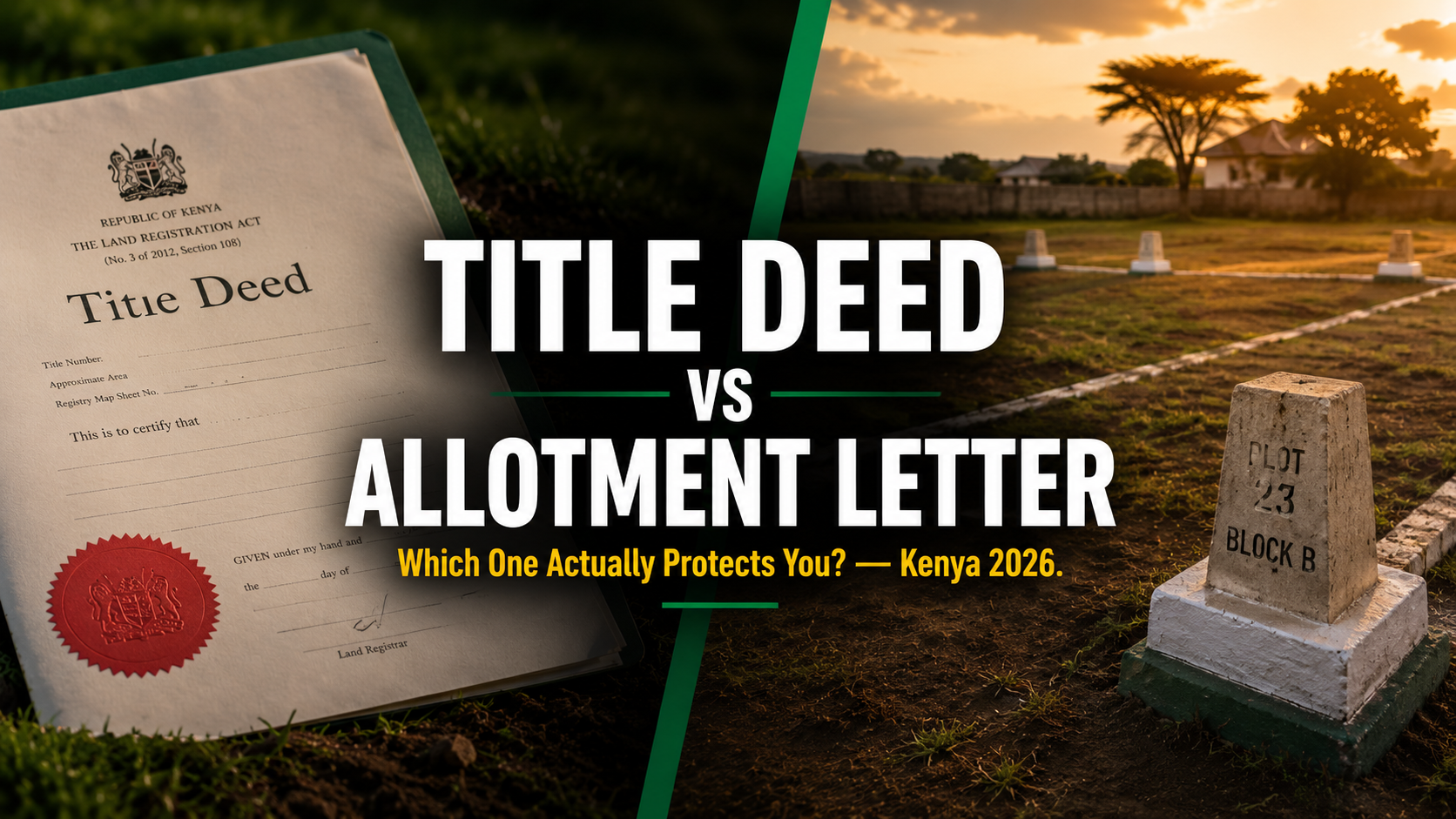

Two documents. Almost identical details — plot number, size, location, your name. But hand over your money for the wrong one, and you could end up with no land, no refund, and a court case you're likely to lose. In Kenya, confusing a title deed with an allotment letter has cost buyers fortunes. Here's the difference that actually matters — and how to protect yourself.
The difference in one line
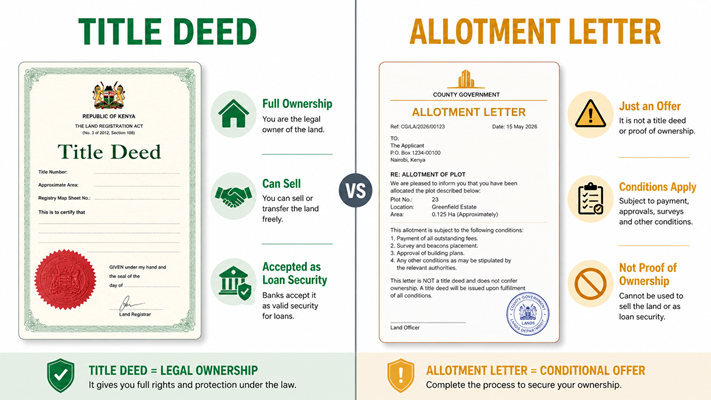
A title deed proves you own the land. An allotment letter only proves you've been offered it. One is ownership; the other is a promise.
What a title deed actually is
A title deed is the conclusive legal proof of land ownership in Kenya. It serves as conclusive evidence of ownership and the legal rights that come with it, and it is issued by the Ministry of Lands at its regional registry offices, with a certificate of title granted by the Registrar upon registration under the Land Registration Act, 2012. It gives you full rights to use, sell, lease, or bequeath the land — and it's what banks accept as security for a loan. There are three main types: Freehold (maximum ownership with no time limit), Leasehold (the right to use land for a set term, commonly 99 or 999 years), and Sectional (ownership of a unit within a larger development, such as an apartment).
What an allotment letter actually is
An allotment letter (letter of allotment) confirms that a specific parcel of public land has been offered to you. It is issued under the oversight of the National Land Commission, which handles plot allocation and the preparation of lease documents on behalf of the national or county government. Critically, it comes with strings attached: it is merely an offer awaiting the fulfilment of specified conditions, including payment of a stand premium and ground rent within prescribed timelines. Typically the offer must be accepted within thirty days, after which it is treated as having lapsed. Until you meet those conditions and a title is registered in your name, the land in question remains public land.
The Supreme Court has settled this
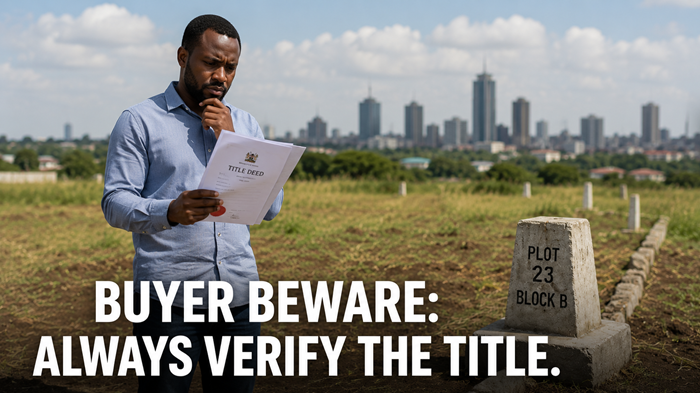
This isn't just lawyerly caution. In the landmark Torino Enterprises case, decided by the Supreme Court on 22 September 2023, the Court ruled that an allotment letter is not a title deed and cannot confer any interest in land. It went further: even a perfected letter of allotment cannot by itself confer transferable title until the buyer is registered as the proprietor of the land. The Court also raised the bar for buyers — placing a duty on purchasers to physically visit and verify the land they intend to buy. The takeaway is blunt: it is the act of registration, not the allotment, that creates a transferable title.
Why this matters to your money
Buy land on the strength of an allotment letter alone and the risks are real. You generally can't use it as valid collateral, because banks require a title deed to secure a mortgage or loan. In a dispute, it may not hold up in court as proof of ownership. And because it carries details so similar to a genuine title, it is a favourite instrument for fraud. If the original allocation was irregular or the conditions were never met, the parcel can be reclaimed — and you may lose everything you paid.
How to turn an allotment letter into a title deed
If you legitimately hold one, here's the path to real ownership: accept the offer within the stated period and pay any outstanding land rent and fees, get the land surveyed and demarcated, then submit your application to the Ministry of Lands, which verifies your documents and, once everything is in order, issues your title deed. The National Land Commission prepares the lease, and much of this can now be initiated online through Ardhisasa.
The bottom line
Never treat an allotment letter as a title deed, and never pay full price for land that only has one. Before any money changes hands:
- Confirm a registered title exists, and run an official land search on Ardhisasa.
- Visit the land physically and check the boundaries against the documents.
- Engage a qualified advocate and a licensed surveyor before paying.
The few thousand shillings you spend verifying ownership is nothing next to the millions you could lose getting it wrong.
This article is general guidance, not legal advice. For any specific transaction, consult a qualified advocate.