


So people have found another way in, and increasingly, that way is the SACCO.
Why mortgages remain out of reach for many Kenyans
Mortgage penetration in Kenya remains extremely low compared to the country's housing demand. For a typical middle income earner, qualifying for a bank mortgage is still hard. Banks generally want formal employment, a strong credit history, proof of stable income, and a deposit of 10 to 20 percent or more upfront. For someone trying to buy a plot or build gradually over several years, that model can feel unrealistic.
SACCOs work differently. Rather than leaning on payslips and credit scores alone, they lend largely against member savings, contribution history, and guarantors. That makes financing far more reachable for teachers, police officers, nurses, small business owners, and other salaried Kenyans who might struggle to tick every box a commercial bank requires.
Just how big SACCOs have become
SACCOs used to be thought of as small community savings clubs. That picture is outdated. By the end of 2025, regulated SACCOs in Kenya held total assets of about KSh 1.21 trillion, according to the Sacco Societies Regulatory Authority (SASRA), with member deposits at roughly KSh 832 billion and a combined loan book of about KSh 948 billion.
Land and housing borrowing makes up a large and growing slice of that lending. In the final quarter of 2025 alone, land purchases accounted for close to KSh 19.5 billion in SACCO loans, with land and housing combined making up more than a quarter of all SACCO credit disbursed that quarter. Across the full year, SACCOs pushed well over KSh 100 billion into land and housing related loans. That is not small community lending anymore. That is a real financing engine for Kenyan homeownership.
How SACCO financing actually supports property ownership
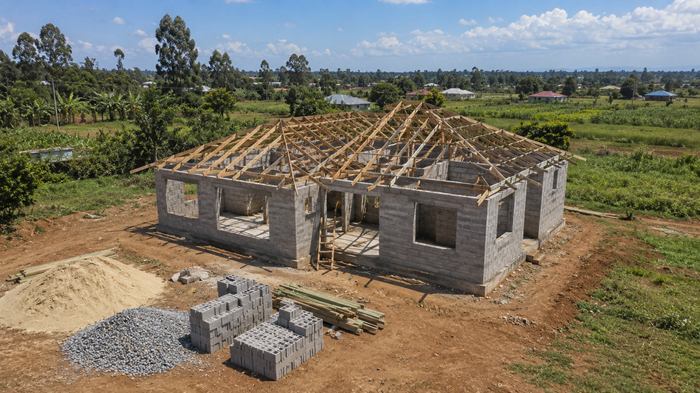
In many countries, people buy a finished home outright through a mortgage. In Kenya, ownership tends to happen in stages: buy a plot first, start building later, finish the house whenever funds allow. SACCO lending fits that pattern far better than a conventional mortgage does.
Members can typically borrow smaller, more flexible amounts over time for:
- Buying land
- Starting or continuing construction
- Finishing touches like tiling, plumbing, or roofing
- Renovating an existing home
There is also a trust factor. Many SACCOs are built around a shared profession, employer, or community, so members are often borrowing from an institution they already know and save with regularly, rather than a bank they only interact with when applying for credit. Large players such as Mwalimu National SACCO and Stima SACCO have expanded their land and housing products specifically to meet this demand, and smaller sector-based SACCOs have followed the same path.

SACCO loan vs bank mortgage: how they actually compare
| Factor | SACCO Land or Housing Loan | Bank Mortgage |
|---|---|---|
| Main qualifying factor | Savings and contribution history with the SACCO | Payslip, employment letter, credit score |
| Typical deposit or savings requirement | Often tied to your accumulated savings, sometimes 3x your savings in loan value | Usually 10 to 20 percent of property value |
| Loan structure | Often smaller, staged loans for land, then construction, then finishing | One larger loan for a near complete property |
| Interest rates | Often lower than commercial bank mortgage rates, though it varies by SACCO | Typically around 12 to 17 percent per annum |
| Best suited for | Buying land and building gradually over time | Buying a near complete or existing property outright |
| Membership requirement | Must be a registered, contributing member | No membership needed, just a bank relationship |
Banks still lead when it comes to large scale mortgages and financing for developers or high value properties. SACCOs are not trying to replace that entirely. What they are doing is closing a gap that conventional mortgages have consistently failed to close, financing ordinary Kenyans who want to buy land and build a home step by step.
What you need to qualify for a SACCO land or housing loan
Requirements vary by SACCO, but most will ask for:
- Active membership with a minimum savings or share capital balance
- A consistent savings and contribution history, usually 6 to 12 months or more
- One or more guarantors who are also members in good standing
- National ID and KRA PIN
- Proof of income, such as payslips or business records
- A clear loan purpose, for example a sale agreement for land or a construction budget
Some SACCOs also require you to have been a member for a minimum period, often a year or more, before you can access larger land or housing loans, so joining early and building your savings history matters.
The step-by-step process
- Join a SACCO that suits you. Many are tied to a profession or employer, but several, like Stima SACCO or Unaitas, accept members from the general public.
- Build your savings and share capital. Most SACCOs base your loan eligibility on a multiple of your savings, so consistent contributions matter more than a single lump sum.
- Line up your guarantors. Ask fellow members in good standing to guarantee your loan, since this is central to how SACCOs underwrite risk.
- Apply for the specific loan product. Land loans, construction loans, and home improvement loans are often separate products with their own terms.
- Submit your documents. ID, KRA PIN, income proof, and the purpose of the loan, such as a sale agreement or a bill of quantities for construction.
- Wait for approval and disbursement. Turnaround is often faster than a bank mortgage, especially for members with a strong savings history.
- Repay through payroll deduction or standing order. Many SACCOs, especially employer-based ones, collect repayments directly from salary.
The challenges SACCOs still face
The growth has not come without concerns. Some SACCOs have faced governance issues, delayed member withdrawals, and liquidity pressure, which has raised real questions about oversight and long-term stability. As SACCOs handle larger sums and bigger property transactions, stronger regulation, better risk management, and more transparency will matter more than ever. Before committing your savings or taking a loan, always confirm the SACCO is licensed and regulated by SASRA, and review its recent financial performance.
So, SACCO or mortgage?
Neither option is universally better. If you want to buy land now and build gradually as your finances allow, a SACCO loan usually fits that reality better than a bank mortgage ever could. If you are buying a finished, high value property and want one clean loan structure, a bank mortgage, especially an affordable-housing product backed by KMRC, may still be the stronger option. Many Kenyans end up using both at different stages of the same journey: a SACCO loan to secure the land and start building, and a mortgage or top-up loan later to finish or refinance.
The bottom line
SACCOs have quietly grown from small savings clubs into one of the biggest forces in Kenyan property financing, and land and housing now make up a major share of what they lend. For Kenyans who find bank mortgages out of reach, a SACCO offers a more realistic, staged path to owning land and building a home. Just make sure any SACCO you join or borrow from is properly regulated, financially sound, and transparent about its numbers before you commit your savings.