


For most Kenyans, paying cash for a home is simply out of reach — and that's exactly what a mortgage is for. It lets you move into your own house now and pay for it over many years, instead of saving for decades. But a mortgage is a serious, long-term commitment, and the difference between a good deal and a costly one comes down to how well you understand the rules. Here's everything you need to know before you apply.
How a mortgage actually works
A lender pays the seller for your home, and you repay the lender in monthly instalments — principal plus interest — over an agreed period, usually 10 to 25 years. The property itself is the security: if you stop paying, the lender can repossess it. You'll choose between a few types — an owner-occupier loan (to live in), a buy-to-let (to rent out), or a construction mortgage (funds released in stages as you build on your own land) — and between a fixed rate (steady repayments) or a variable rate (moves with the market). Sharia-compliant options are also available from select banks.
What you'll pay: interest rates
This is where homework pays off. Standard mortgage rates in Kenya typically run between about 12% and 17% per annum, with the average sitting around 14–15%; the most competitive commercial-bank rates start near 12%. Most mortgages are variable, meaning your repayment rises or falls when the Central Bank adjusts its base rate. A fixed rate costs a little more for the certainty of unchanging payments. (There's a cheaper route still — more on that below.)
What you'll need: deposit and eligibility
Expect to put down a deposit of 10–20% of the property's value (some lenders ask up to 30%, while a few finance up to 90–100% for very strong borrowers, at higher rates). A bigger deposit means a smaller loan, lower interest, and easier approval. For example, on a KSh 6 million home, a 20% deposit is KSh 1.2 million, and the bank finances the remaining KSh 4.8 million.
To qualify, most banks want a gross monthly salary of roughly KSh 100,000–150,000 for a standard mortgage (affordable-housing products often have lower thresholds), plus a clean credit history. As a rule, keep total loan repayments under about 35–40% of your net income. Self-employed applicants need 2–3 years of audited accounts, KRA tax compliance, and 6–12 months of business bank statements. Diaspora Kenyans and foreigners can also qualify with proof of foreign income and certified statements, sometimes with a higher deposit.
Documents to prepare
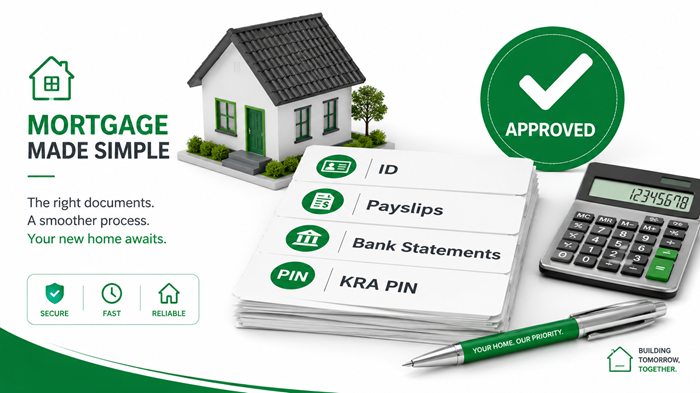
Have these ready before you apply:
- National ID or passport, and your KRA PIN and tax compliance certificate.
- Recent payslips (3–6 months) and an employment letter — or, if self-employed, audited accounts and business statements.
- Bank statements (6–12 months).
- Proof of your deposit.
- The property documents (title, sale agreement).
The application process, step by step
- Check affordability and credit. Use a lender's mortgage calculator, keep repayments comfortable, and check your CRB credit status — clean up any issues first.
- Get pre-qualified. A soft check tells you how much you can borrow without denting your credit score.
- Compare lenders. Rates, fees, and terms vary widely across banks like KCB, Co-op, Equity, Stanbic, Absa, NCBA, Standard Chartered, and HF Group.
- Choose your property and apply. Submit your application with the full document set.
- Valuation and due diligence. The bank values the property and verifies its title and legal status.
- Approval and offer. Read the offer letter carefully — rate, term, fees, and penalties.
- Legal completion. Conveyancing, stamp duty, and registering the lender's charge on the title.
- Disbursement. Funds go to the seller, and your monthly repayments begin.
Expect roughly 30–60 days (sometimes up to 12 weeks) from application to disbursement.
The cheaper route: affordable-housing mortgages
Here's what far too few buyers ask about. The Kenya Mortgage Refinance Company (KMRC) supplies banks and SACCOs with cheaper long-term funds so they can offer lower-rate affordable-housing mortgages — often around 9–10%, well below standard rates. If your target home falls within the affordable-housing price band, ask lenders specifically about a KMRC-backed loan, and look into the government's Boma Yangu affordable-housing programme. It's the single biggest lever for cutting your interest bill.
The costs people forget

Beyond the deposit, budget for a property valuation fee, legal/conveyancing fees, stamp duty on the transfer, a bank arrangement/processing fee, and mortgage and property insurance. Together these add a meaningful sum on top of your deposit — plan for them so they don't catch you short at completion.
Borrow with your eyes open
Most Kenyan mortgages are variable-rate, so your repayments climb if the Central Bank Rate rises. Borrow conservatively: stay well within your means, favour a fixed rate where you can, and never forget that your home can be repossessed if you fall behind. The goal isn't just to get approved — it's to comfortably keep paying for the next 20 years.
The bottom line
A mortgage can turn years of saving into keys in your hand far sooner — but only if you go in informed. Know the rate you're signing, keep your repayments comfortable, chase the cheaper affordable-housing options, and compare lenders before you commit. Do that, and homeownership in Kenya is far more achievable than it looks.