


A 2-bedroom house is the dream starting point for most Kenyan families — big enough to be comfortable, small enough to actually afford. But "afford" looks very different in 2026 than it did even a year ago. Material and labour prices have climbed again, and the gap between a budget build and a quality one is wide. So what will it really cost you this year? Here's the honest, up-to-date breakdown.
The short answer: In 2026, building a permanent (stone or concrete-block) 2-bedroom house in Kenya costs roughly KSh 2 million to KSh 6 million-plus, depending on size, location, and finishes. Most well-built mid-range homes land between KSh 3 million and KSh 5 million. A budget mabati (iron-sheet) 2-bedroom can be done for as little as KSh 300,000 to KSh 1 million.
First, how big is a 2-bedroom house?
Cost is driven first by floor area. A typical 2-bedroom house in Kenya runs between 60 and 90 square metres. Because builders price work per square metre, your total is essentially your size multiplied by a rate that depends on how well you finish the home. Nail down both numbers and you can estimate your budget in minutes.
Cost by finish level (2026)
| Build type / finish | Cost per m² | 70 m² 2-bed total |
|---|---|---|
| Mabati (budget) | — | KSh 300K – 1M |
| Basic permanent (stone/block) | KSh 45,000 – 50,000 | ≈ KSh 3.2M – 3.5M |
| Mid-range (most common) | KSh 55,000 – 70,000 | ≈ KSh 3.9M – 4.9M |
| High-spec / modern | KSh 90,000 – 120,000+ | ≈ KSh 6.3M – 8.4M+ |
Rates are 2026 estimates and shift with location and market conditions.
A quick worked example
Say you're building a 70 m² 2-bedroom home. At a basic finish (around KSh 48,000/m²) you're looking at roughly KSh 3.4 million. Bump it to a comfortable mid-range finish (around KSh 60,000/m²) and it rises to about KSh 4.2 million. Go high-spec with quality tiles, fittings, and a modern design (KSh 95,000/m² or more) and you'll cross KSh 6.5 million. Same house — the finishes decide the price.
The budget route: a mabati house
If your budget is tight, a mabati (iron-sheet) house is the fastest, cheapest path. A 2-bedroom can be completed in weeks rather than months for somewhere between KSh 300,000 and KSh 1 million. It's a practical choice for a rural plot or a starter home — though a permanent stone house holds its value far better over the long term.
Where your money actually goes
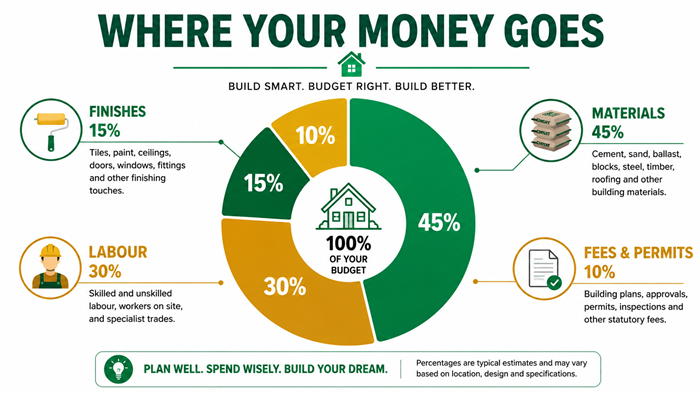
Roughly speaking, materials swallow 40–50% of your budget, labour takes 25–35%, and the rest goes to finishes, professional fees, and permits. The spend also flows in stages: the foundation and substructure, the walling (superstructure), the roofing, then the finishes — plaster, tiles, paint, doors, windows, plumbing, and electrical. Finishes are where budgets quietly balloon, because the choice between basic and premium fittings can swing the total by millions.
What pushes the price up — or down
Several factors decide where on the range you land. Location matters most: building in Nairobi and other cities costs noticeably more than in rural areas, thanks to pricier land, labour, and material transport. Design complexity adds up too — a simple rectangular plan is far cheaper to build than one with many corners, levels, or a complicated roof. And your material choices, from the type of blocks and roofing down to the grade of tiles and fittings, set the baseline for everything else.
5 smart ways to cut costs (without cutting corners)
- Keep the design simple. A clean, rectangular layout is cheaper to build and just as livable.
- Use quality local materials and local labour where you can — it cuts both transport and wage costs.
- Build in phases if cash flow is tight: complete the structure first, then finish later.
- Get at least three quotes from suppliers and contractors, and compare them line by line.
- Hire a quantity surveyor early. A good one pays for themselves by giving you an accurate budget and stopping waste.
The costs people forget
First-time builders almost always underestimate the extras. Beyond the build itself, budget for county approvals and permits, professional fees (architect, engineer, surveyor), and utility connections for water, electricity, and sometimes a septic tank or borehole. These alone can add KSh 150,000 to KSh 800,000 or more to your total.
The bottom line
Building a 2-bedroom home in Kenya in 2026 is very achievable — but only with a realistic budget and the right team. Decide your finish level early, calculate using your actual planned floor area, and never break ground without an accurate estimate from a quantity surveyor and a licensed (NCA-registered) contractor. Plan well, and your KSh 3–5 million can deliver a home you'll be proud of for decades.
All figures are 2026 estimates and vary by location, market conditions, and project specifics. Always get a professional quotation before committing your budget.