


Walk onto any building site and you'll hear the same anxious question: "How many bags do we order?" Guess too low and work stops while someone runs to the supplier; guess too high and your money sits in a pile getting rained on. The truth is, the quantities are completely predictable — concrete is just cement, sand, and ballast in fixed proportions. Here's exactly how much of each you need per cubic metre, for every common mix, plus the simple formula to scale it to any job.
The quick reference: per 1 m³ of concrete
| Mix (cement : sand : ballast) | Typical use | Cement (50 kg bags) | Sand | Ballast |
|---|---|---|---|---|
| 1 : 4 : 8 | Mass concrete / blinding | ~3.4 | 0.47 m³ (~0.8 t) | 0.95 m³ (~1.4 t) |
| 1 : 3 : 6 | Class 10 — mass concrete | ~4.5 | 0.46 m³ (~0.7 t) | 0.92 m³ (~1.4 t) |
| 1 : 2 : 4 | Class 20 — foundations & slabs | ~6.5 | 0.44 m³ (~0.7 t) | 0.88 m³ (~1.3 t) |
| 1 : 2 : 3 | Class ~25 | ~7.5 | 0.51 m³ (~0.8 t) | 0.77 m³ (~1.2 t) |
| 1 : 1.5 : 3 | Class 25 — columns & beams | ~8 | 0.42 m³ (~0.7 t) | 0.84 m³ (~1.3 t) |
| 1 : 1 : 2 | Class 30 — high-strength | ~11 | 0.39 m³ (~0.6 t) | 0.77 m³ (~1.2 t) |
Figures are per cubic metre of finished concrete, using 50 kg cement bags and standard material densities. They're rounded for ordering.
How the calculation works
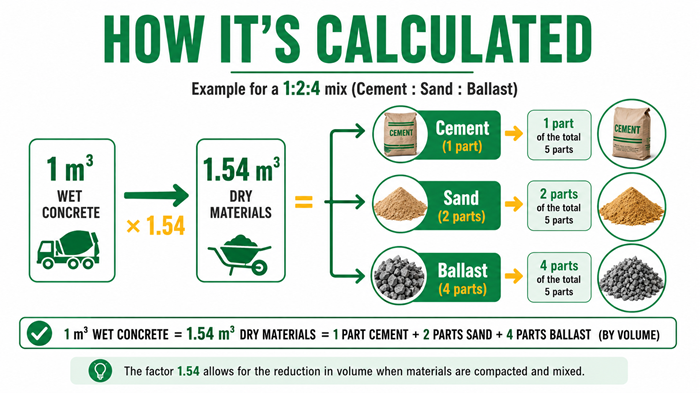
Those numbers come from one simple, standard process. For any amount of concrete:
- Start with the wet volume — the finished concrete you need (say 1 m³).
- Convert to dry volume. Loose, dry materials take up more space than the compacted concrete they become, so you multiply by 1.54. One cubic metre of concrete needs about 1.54 m³ of dry materials.
- Split by the mix ratio. Add up the parts — for 1:2:4 that's 1 + 2 + 4 = 7 — then give each material its share of the 1.54 m³: cement gets 1/7, sand 2/7, ballast 4/7.
- Convert to buying units:
- Cement — one 50 kg bag is about 0.0347 m³, so divide the cement volume by 0.0347 to get bags.
- Sand — about 1.6 tonnes per m³.
- Ballast — about 1.5 tonnes per m³.
That's the entire method. Everything else is just multiplication.
A worked example
Say you're casting a concrete slab measuring 5 m Ã- 4 m Ã- 0.15 m. That's 3 m³ of concrete. Using a standard 1:2:4 mix, just multiply the per-cubic-metre figures by 3:
- Cement: 6.5 Ã- 3 = ~20 bags
- Sand: 0.44 m³ Ã- 3 = 1.32 m³ ≈ 2.1 tonnes
- Ballast: 0.88 m³ Ã- 3 = 2.64 m³ ≈ 4 tonnes
Three numbers, no surprises at the gate.
From cubic metres to tonnes to lorries
Suppliers usually sell sand and ballast by the tonne, and deliver by the lorry, so it helps to think in those units. Using the densities above, sand runs about 1.6 tonnes per cubic metre and ballast about 1.5 tonnes per cubic metre. A typical 7-tonne tipper, then, carries roughly four to five cubic metres — so a small slab like the one above sits comfortably within a single load, while a big foundation pour will need several.
A few things that change the numbers
- Always add a little extra. Build in 5–10% for wastage — spillage, over-excavation, and what sticks to the mixer.
- Nominal mixes have limits. The ratios above are fine for general work, but structural elements (suspended slabs, columns, beams carrying load) should follow an engineer's design mix, not a rule of thumb.
- Bag size matters. These figures assume 50 kg bags; adjust if your cement comes in a different size.
- Wet sand lies. Very damp sand "bulks up" and can throw your volume off, so buy from a consistent source and measure carefully.
Skip the math entirely
You don't have to do any of this by hand. Our Foundation Concrete Calculator runs the whole formula for you — enter your perimeter, width, depth, and mix, and it returns the exact bags of cement, tonnes of sand and ballast, lorry loads, and cost, with the working shown. Plug in your numbers and order with confidence.
The bottom line
Concrete quantities aren't a mystery — they're arithmetic. Know your volume, multiply by 1.54, split by your mix ratio, and convert to bags and tonnes, and you'll order exactly what you need: no costly stoppages, no wasted materials baking in the sun. Keep this table handy, add a little for wastage, and let the calculator handle the rest.