


Kenyans abroad sent home a record sum in 2025, and a significant share of that money goes straight into land and property, buying a plot, building the family home, or investing in a rental unit for the long term. It is also true that the same distance that makes this possible, working and earning abroad, is exactly what fraudsters exploit. Diaspora buyers are consistently the most targeted group for property fraud in Kenya, precisely because verifying anything from thousands of kilometres away is genuinely hard. Here is how to do this safely.
Can Kenyans abroad legally buy and build?
Yes, without restriction. Kenyan citizens abroad retain full rights to buy land, build, and hold title exactly as they would if resident in Kenya. The practical challenge has never been legal eligibility, it is oversight: verifying a title, supervising construction, and catching problems early when you cannot simply drive out to the plot yourself.
Documents you will need
- A valid Kenyan passport or national ID
- A KRA PIN certificate
- Six to twelve months of bank statements from your country of residence
- Proof of employment or income
- Proof of your residential address abroad
- The relevant property documents, including the sale agreement once you have identified a plot
Power of Attorney, and why it needs careful limits
Since you cannot always be physically present for signings, a Power of Attorney (PoA) lets a trusted representative, often an advocate or close family member, act on your behalf in Kenya. This document generally needs to be notarised at a Kenyan embassy or by an internationally recognised notary in your country of residence, then apostilled before it carries legal weight in Kenya.
Two things matter enormously here:
- Limit the scope tightly. A PoA should cover the specific transaction only, with a defined expiry date. There have been real cases of a PoA granted for one purpose being misused for additional, unauthorized transactions later.
- The PoA flows one direction only. You grant it to your own representative. If a seller or agent ever asks you to sign a PoA in their favour, or in favour of someone connected to them, treat that as an immediate red flag, not a normal part of the process.

How the buying process actually works remotely
- Identify the land and get an independent search done. Never rely solely on documents the seller provides. Ardhisasa now allows real-time title verification for parcels in covered counties, and a formal search certificate should be obtained regardless.
- Engage your own Kenyan advocate, not one recommended or provided by the seller. Verify their practising status through the Law Society of Kenya before proceeding.
- Never wire money directly to a seller or agent. Funds should go into your advocate's client escrow account, released only once the necessary verifications and legal steps are complete.
- Grant a properly scoped Power of Attorney if you need someone to sign on your behalf for any step requiring physical presence.
- Pay stamp duty through official digital channels. Kenya's stamp duty is currently 4 percent of property value for urban land and 2 percent for rural land, and payments are now processed digitally through the Ardhipay module on Ardhisasa. Keep every receipt.
- Complete registration and title transfer. This is handled by your advocate at the relevant Land Registry, and typically takes 60 to 120 days after full payment, depending on the county and how complete the documentation is.
Building from abroad: what changes
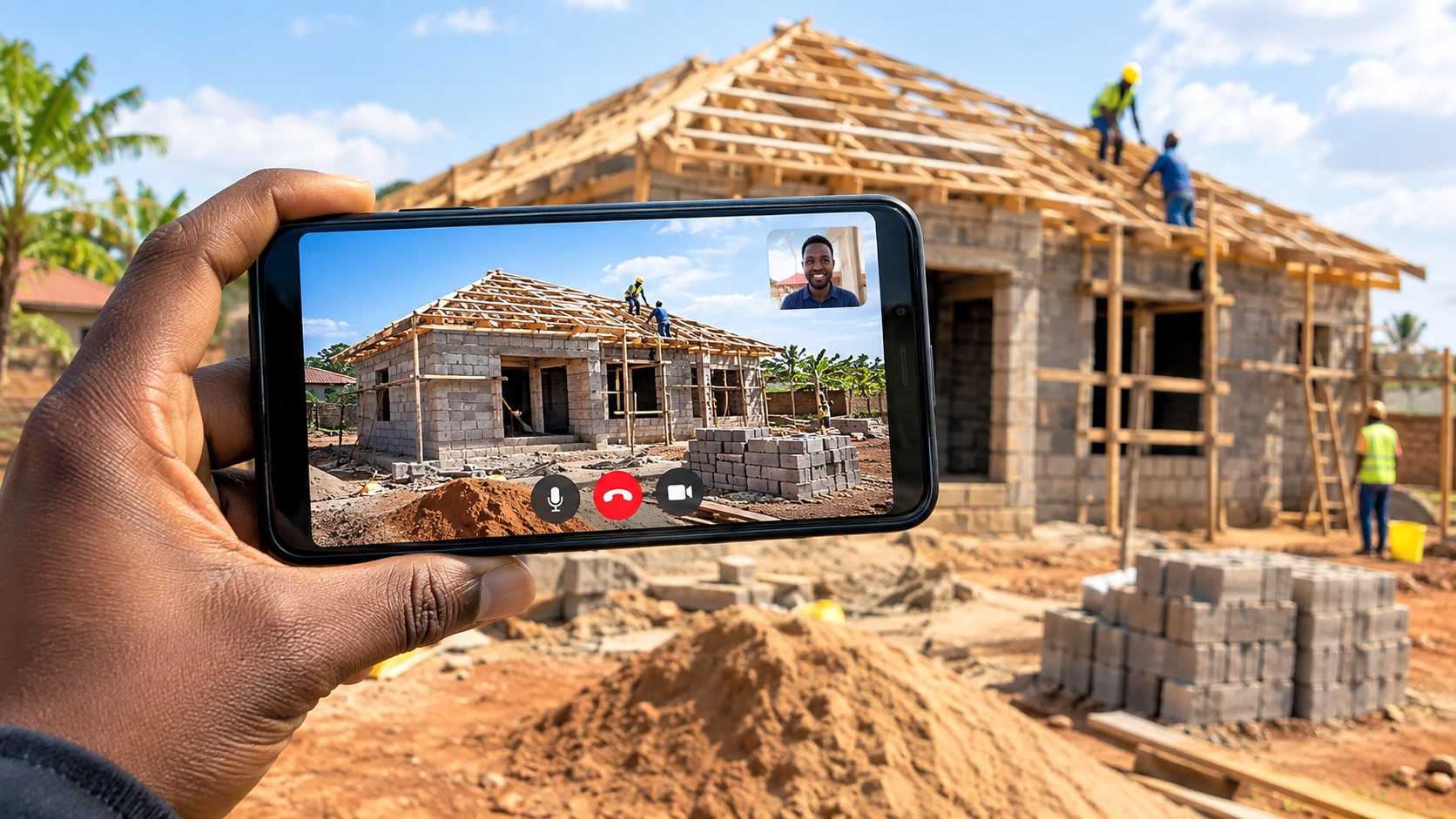
Buying the plot is only step one for many diaspora families. Building the actual house from abroad introduces a second layer of risk, mainly around supervision and payment structure.
- Construction costs currently run roughly KSh 35,000 to over KSh 100,000 per square metre, depending on finish level, similar to costs for anyone building in Kenya, diaspora status does not change the underlying pricing.
- Confirm NCA registration for your contractor, and check BORAQS registration for the architect or engineer overseeing the design and structural work.
- Grant a limited Power of Attorney to a trusted person specifically for in-person signings and approvals, separate from any land purchase PoA.
- Hire independent supervision on site. This should be someone with no financial relationship to your contractor, whose only job is verifying that what you are being billed for is actually being built.
- Use milestone-based payments tied to verified progress, not a lump sum handed over upfront or a payment schedule based purely on time elapsed rather than work completed.
Fraud patterns that specifically target diaspora buyers
- Slick, professional-looking marketing aimed directly at Kenyans abroad, including polished social media campaigns for off-plan units on land the seller does not actually own.
- Urgency pressure, phrases like "another buyer is looking at it this weekend," designed to rush a decision before you can properly verify anything.
- A seller or agent requesting a Power of Attorney in their favour, rather than you granting one to your own representative.
- Requests to wire funds to a personal account rather than a verified law firm client account or regulated escrow.
- Fraudulent companies that quietly close and reopen under a new name after taking deposits, making legal recourse difficult even when a case is reported.
Real victims of these schemes have included nurses, drivers, and teachers working double shifts abroad, with individual losses reported from several million shillings up to tens of millions in the worst documented cases. Government policy commitments toward better diaspora protections exist on paper, but until enforcement genuinely catches up, your own due diligence remains the only reliable safeguard.
Where diaspora buyers are currently investing
For established rental demand and tenant quality, areas like Westlands, Kileleshwa, Kilimani, and Lavington remain consistently strong. For lower entry points and faster capital appreciation, satellite towns including Ruiru, Ruaka, Syokimau, and Juja have been posting some of the highest growth rates in the market. For the luxury segment, Karen, Runda, and Gigiri continue to attract a stable, high-income tenant pool.
The bottom line
Buying land and building in Kenya from abroad is entirely legal and, when done correctly, genuinely achievable without ever getting on a plane. The systems that make this possible, digital title verification, notarised Power of Attorney, remote legal representation, have matured significantly. But the same distance that makes remote investing convenient is exactly what fraudsters count on. Verify everything independently, never send money directly to a seller, keep any Power of Attorney narrowly scoped, and treat urgency or resistance to normal due diligence as a reason to slow down, not speed up.